Meet Founder Sarah Besse
Every Child Outdoors grew from a belief that play and learning with nature are essential parts of childhood. In this conversation, Sarah shares the experiences and ideas behind that work.
What led you to nature-based early childhood education?
This story begins long before I ever knew about forest kindergartens. At the New York City public elementary school I attended, our recess area was blacktop, but a London plane tree grew just beyond the chain-link fence, its branches reaching into the schoolyard. I remember children pulling leaves from those branches so they could hold them, feel them, and play with them. They were literally pulling nature toward themselves, an instinct researchers call biophilia, the deeply human need for connection with living beings.
Fortunate to have had access to nature outside of school, I learned early how to grow vegetables, did not fear insects, and felt comfortable hiking in the rain. Few of my classmates had those same opportunities. This contrast stayed with me and shaped my belief that nature connection is essential for personal and societal wellbeing.
Years later, I was teaching at a public school. One day, I brought full stalks of “glass gem” corn from my garden into the classroom. My preschool children examined the roots, stalks, leaves, and silk, removed kernels from the cobs, sorted them by color, counted them, and created artwork. To me, this was engaging hands-on interdisciplinary learning. A supervisor walked by and remarked “Oh, we only do science on Fridays.” But this was not simply science; it was also language, art, math, and social studies.
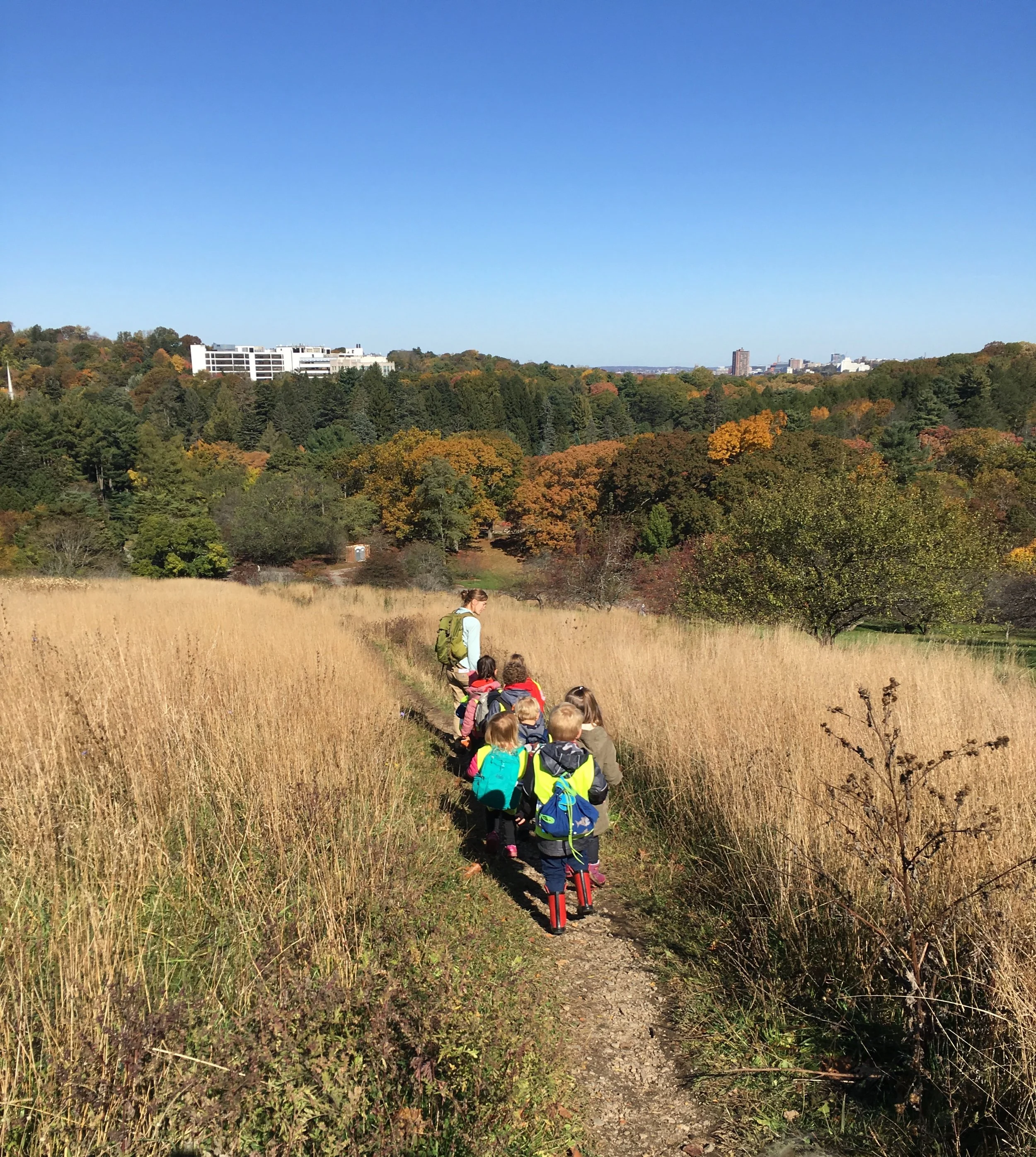
Around that same time, I watched the documentary School’s Out: Lessons from a Forest Kindergarten, which changed the course of my life. Seeing a forest kindergarten in Switzerland and realizing that children had been learning this way in Europe for generations made me want to create experiences like these for Boston children. I opened my first nature preschool class in 2019 and have been building and learning ever since, always with the goal of making these experiences more accessible.
How did you decide on the name Every Child Outdoors?
Our name reflects our belief that play, exploration, and learning with nature are essential parts of childhood, and that every child should have access to these experiences.
Our nickname, “ECO,” felt right too. Ecology is the study of relationships between living things and the places they inhabit. That resonates with me because our work is ultimately about relationship: between children and nature, and with one another in community.
As nature educator David Sobel writes, “If children are to flourish, to become truly empowered, then let us allow them to love the Earth before we ask them to save it.”
What is ECO’s educational philosophy?
Our approach is play-based and nature-immersive. From Montessori, we draw an emphasis on purposeful activity and the development of order, concentration, coordination, and independence. From Waldorf, we draw the importance of imagination, beauty, rhythm, and wonder. From Reggio Emilia, we draw the view of children as capable thinkers and the practice of listening closely to their ideas and questions.
Our work is also informed by critical pedagogy. Paulo Freire wrote: “There is no such thing as neutral education. Education either functions as an instrument to bring about conformity or freedom.” Freire emphasized education rooted in dialogue, inquiry, and participation rather than passive transmission of information. When children make mud pies, build forts, investigate insects, negotiate conflict, or care for living things, they are not passive recipients of knowledge; they are observing, questioning, collaborating, and participating in the world around them, developing habits of mind that foster lifelong learning.
Educator Wen Hu helps ground these ideas in the daily life of early childhood education. Asking “What does justice mean in childcare?” Hu writes:
“In early learning environments, justice is not an abstract concept—it is lived through everyday interactions and relationships. From my perspective, justice in childcare includes:
Equity – Supporting each child according to their individual needs, rather than treating all children the same.
Belonging – Ensuring every child and family feels seen, valued, and represented within the program.
Respect and Voice – Honouring children’s ideas, choices, and rights, and creating space for their voices to be heard.”
Equity, belonging, and voice are also the building blocks of democracy. As John Dewey wrote, democracy is “more than a form of government; it is primarily a mode of associated living.”
Why do we return to the same trees and places throughout the seasons?
At ECO, children do not simply spend time outdoors. They build a meaningful relationship with nature by returning to the same trees and places again and again throughout the seasons.
Biologist and Arnold Arboretum Director Ned Friedman writes that environmental education can help people develop “a personal and lifelong connection with the other, the vast and variant organisms with which we share the planet.” This perspective informs our educational practice. Children learn to care for the living world by coming to know particular living organisms.
Young children notice with their whole bodies and senses. They watch buds swell and smell flowers. They compare bark with their hands. They notice where moss grows, where birds gather, where acorns collect, and how leaves change color and texture over time. As children revisit familiar places, their observations become more detailed.
Friedman writes that “there is no single ‘right’ way to observe a tree or any other organism,” but that careful observation begins by “avoiding making that organism a mere extension of your self.” He invites us to observe living organisms on their own terms, not only through the lens of human use or meaning. A tree is not simply scenery or a teaching prop. It is a living organism with its own structure, seasonal rhythms, and ecological relationships.
This perspective influences how we think about nature education. At ECO, children encounter plants, animals, weather, and seasons not merely as background for activity, but as parts of the living world worthy of study. Ecological awareness grows through familiarity, observation, and repeated encounters with particular places and organisms.
What Is One of Your Daily Routines at ECO’s Nature Preschool?
Each day, we express gratitude for the earth and for one another through speech, music, visual art, and/or movement. We invite children to reflect on their day and to notice something they are grateful for — a friendship, a bird sighting, an adventure, or the feeling of sunshine or rain.
Our gratitude practices provide an opportunity for children to develop a daily habit of reflection. In addition, research suggests that gratitude can support emotional wellbeing and social connection. We hope children come to understand themselves not as separate from nature, but as participants in a larger ecological community.
How has the nature-based early education movement grown over time and how have you been part of it?
Nature preschools, outdoor preschools, and forest schools have grown rapidly across the United States. According to the Natural Start Alliance, nature preschools in the United States grew from roughly 250–300 programs in 2017 to an estimated 800 programs serving 25,600 children by 2022–23 — an increase of more than 200% in just five years.
When I launched Boston Outdoor Preschool Network (BOPN) in 2019, we were one of only a few nature preschools in the Boston area, and the first to operate entirely outdoors. It has been exciting to contribute to such a rapidly growing movement.
Over the past seven years, I have launched nature preschools across the Boston area and seen firsthand how transformative this model can be for children, families, educators, and communities. At this stage in my career, I am excited not only to lead programs, but also to grow the movement by helping others bring their visions to life. I am currently supporting a pair of teachers to launch a nature preschool in Sudbury and look forward to doing more consulting work in the years ahead.
I am also eager to spend more time teaching. After many years of overseeing multiple locations, I am excited to focus on ECO’s one preschool class in Roslindale (launching September) while continuing to support the broader movement. I love both the daily work of teaching young children and the creative work of building innovative partnerships to expand access to nature-based education. ECO provides the opportunity to do both.
What makes a great ECO teacher?
ECO teachers need not only strong teaching skills, but also a deep commitment to children’s right to play and learn with nature.
Great teaching is reflective work. Margie Carter and Deb Curtis write that when teachers are treated as thinkers and learners, they bring that same orientation to children. At ECO, we strive to create the kind of environment where teachers are given time to observe, space to reflect, and opportunities for thoughtful dialogue.
At ECO, we value intellectual curiosity and emotional intelligence. Teachers pay close attention to children’s interests, are fascinated by child development, and approach the natural world with wonder.
In her book Really Seeing Children, Deb Curtis challenges educators to move beyond quick judgments and habitual interpretations. Observation is not simply note-taking or supervision, but a process of careful study and reflection. Teachers become researchers, documenting what they notice and asking: What is this child trying to understand? What theories are they forming? What relationships are emerging here?
This way of seeing requires attentiveness and humility. At ECO, teachers make meaning from observation and allow children’s questions, interests, and discoveries to shape the learning environment.
Can you share a book that has influenced your work with children?
I keep coming back to From Teaching to Thinking by Ann Pelo and Margie Carter. Schools can become so occupied with routines and schedules that we stop asking why we do what we do. This book invites educators to ask deeper questions: What is the purpose of education? What kind of people do we want to be? What kind of world do we want to live in?
This passage especially resonates with me: “Our work is rooted in the immediacy of what is unfolding, rather than narrowly focused on the achievement of learning goals, or the eventuality of assessments, or the replication of routines. The immediacy of what’s unfolding–leaves bright in the autumn sun, then dead on the winter ground, then budding into spring’s brightness–and the questions that these leaves spark, the thinking that they stimulate, the sense of living in a particular place in a particular season that they strengthen. Weigh all that against a list of learning outcomes and the assessments meant to measure children’s knowledge: Where will we find the richer insights into how and what children think and wonder and communicate and imagine?”
What are a few of your favorite children’s books and nature guides?
Hiking Day by Anne and Lizzy Rockwell and Hike by Pete Oswold are wonderful introductions to nature preschool. They show children and families hiking and exploring outdoors together, observing plants and animals, and deepening their connection with both nature and one another.
Forest Tracks by Dee Dee Duffy invites children into a fun guessing game as they follow animal tracks and guess which creature left them behind.
Forest Has a Song by Amy Ludwig Vanderwater and Robin Gourley celebrates the natural world through playful poetry. A child in my class burst into laughter at the phrase “socks of moss,” followed by the rest of the group gleefully repeating it. Books like this support language development by celebrating words, imagery, and the expressive possibilities of language.
I Am An Artist by Pat Lowery Collins and Robin Brickman shows us that art begins with paying attention. Through poetic language and nature illustrations, the book celebrates observation, imagination, and creative expression in the natural world.
What Does Brown Mean to You? By Ron Grady is a celebration of identity, family, and belonging. It’s always a special treat when Ron visits our class to share his books through a read-aloud with the children!
The Pocket Naturalist guides, especially Urban Wildlife, and the Kaufman Field Guide to Nature of New England by Kenn and Kimberly Kaufman help children “talk local” by identifying the plants, animals, tracks, and habitats in our area.
What do you do for fun?
I love gardening, and ECO recently gave away hundreds of strawberry plants to early childhood programs, schools, and nonprofits across the Boston area. I also play in a flute ensemble and am learning to play the harp.