Philosophy of Education
What follows is a brief excerpt from a May 2026 interview with ECO Founder Sarah Besse. See the full interview HERE.
What is ECO’s educational philosophy?
Our approach is play-based and nature-immersive. From Montessori, we draw an emphasis on purposeful activity and the development of order, concentration, coordination, and independence. From Waldorf, we draw the importance of imagination, beauty, rhythm, and wonder. From Reggio Emilia, we draw the view of children as capable thinkers and the practice of listening closely to their ideas and questions.
Our work is also informed by critical pedagogy. Paulo Freire wrote: “There is no such thing as neutral education. Education either functions as an instrument to bring about conformity or freedom.” Freire emphasized education rooted in dialogue, inquiry, and participation rather than passive transmission of information. When children make mud pies, build forts, investigate insects, negotiate conflict, or care for living things, they are not passive recipients of knowledge; they are observing, questioning, collaborating, and participating in the world around them, developing habits of mind that foster lifelong learning.
Educator Wen Hu helps ground these ideas in the daily life of early childhood education. Asking “What does justice mean in childcare?” Hu writes:
“In early learning environments, justice is not an abstract concept—it is lived through everyday interactions and relationships. From my perspective, justice in childcare includes:
Equity – Supporting each child according to their individual needs, rather than treating all children the same.
Belonging – Ensuring every child and family feels seen, valued, and represented within the program.
Respect and Voice – Honouring children’s ideas, choices, and rights, and creating space for their voices to be heard.”
Equity, belonging, and voice are also the building blocks of democracy. As John Dewey wrote, democracy is “more than a form of government; it is primarily a mode of associated living.”
Why do we return to the same trees and places throughout the seasons?
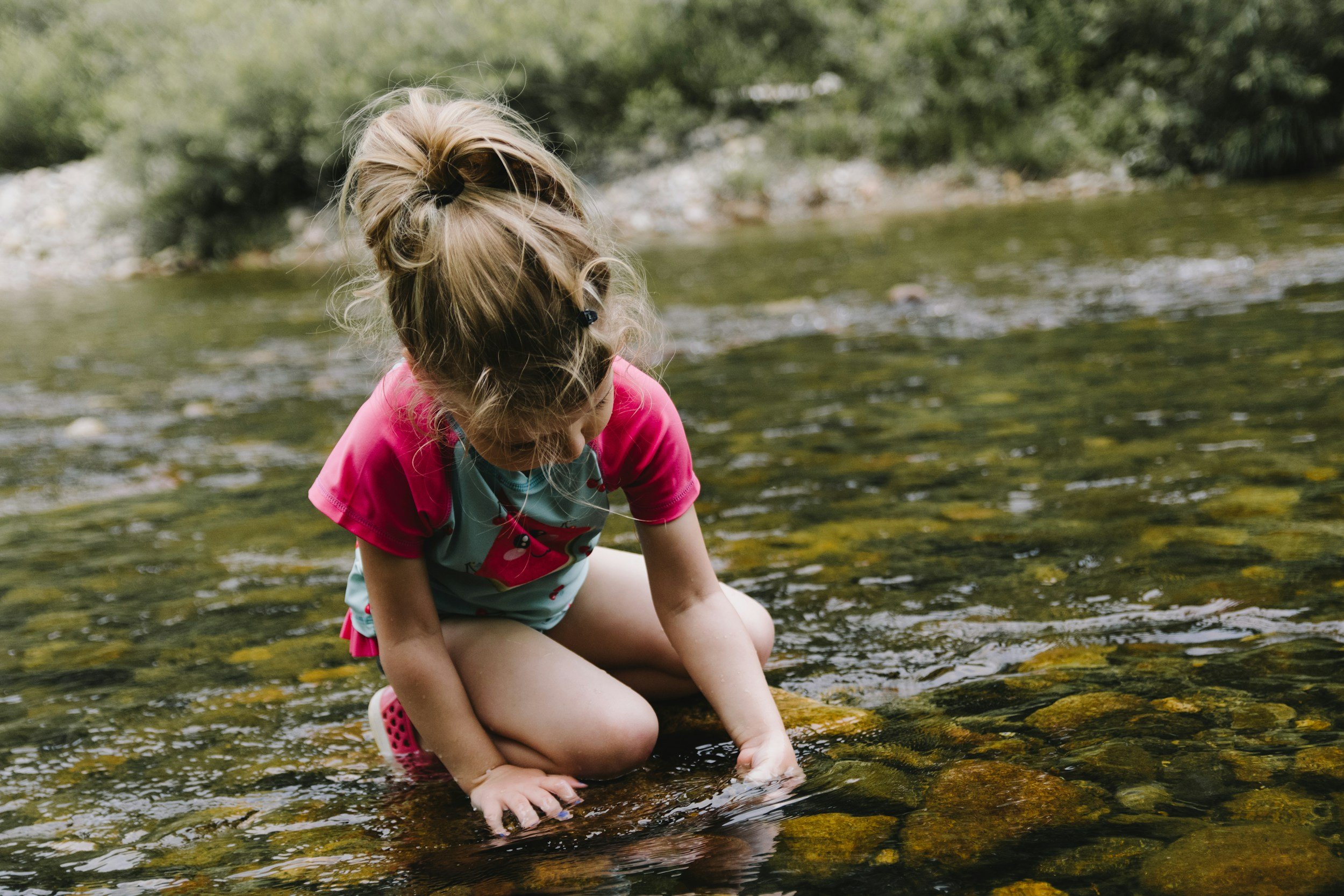
At ECO, children do not simply spend time outdoors. They build a meaningful relationship with nature by returning to the same trees and places again and again throughout the seasons.
Biologist and Arnold Arboretum Director Ned Friedman writes that environmental education can help people develop “a personal and lifelong connection with the other, the vast and variant organisms with which we share the planet.” This perspective informs our educational practice. Children learn to care for the living world by coming to know particular living things.
Young children notice with their whole bodies and senses. They watch buds swell and smell the flowers. They compare bark with their hands. They notice where lichens grow, where birds gather, where acorns collect, and how leaves change color and texture over time. As children revisit familiar places, their observations become more detailed and specific.
Friedman writes that “there is no single ‘right’ way to observe a tree or any other organism,” but that careful observation begins by “avoiding making that organism a mere extension of your self.” He invites us to observe living organisms on their own terms, not only through the lens of human use or meaning. A tree is not simply scenery or a teaching prop. It is a living organism with its own structure, seasonal rhythms, and ecological relationships.
This perspective influences how we think about nature education. At ECO, children encounter plants, animals, weather, and seasons not merely as background for activity, but as parts of the living world worthy of study. Ecological awareness grows through familiarity, observation, and repeated encounters with particular places and organisms.